Pages

Tampilkan postingan dengan label Human Endocrine System. Tampilkan semua postingan

Senin, 25 Maret 2013

POSTERIOR PITUITARY GLAND


POSTERIOR PITUITARY GLAND

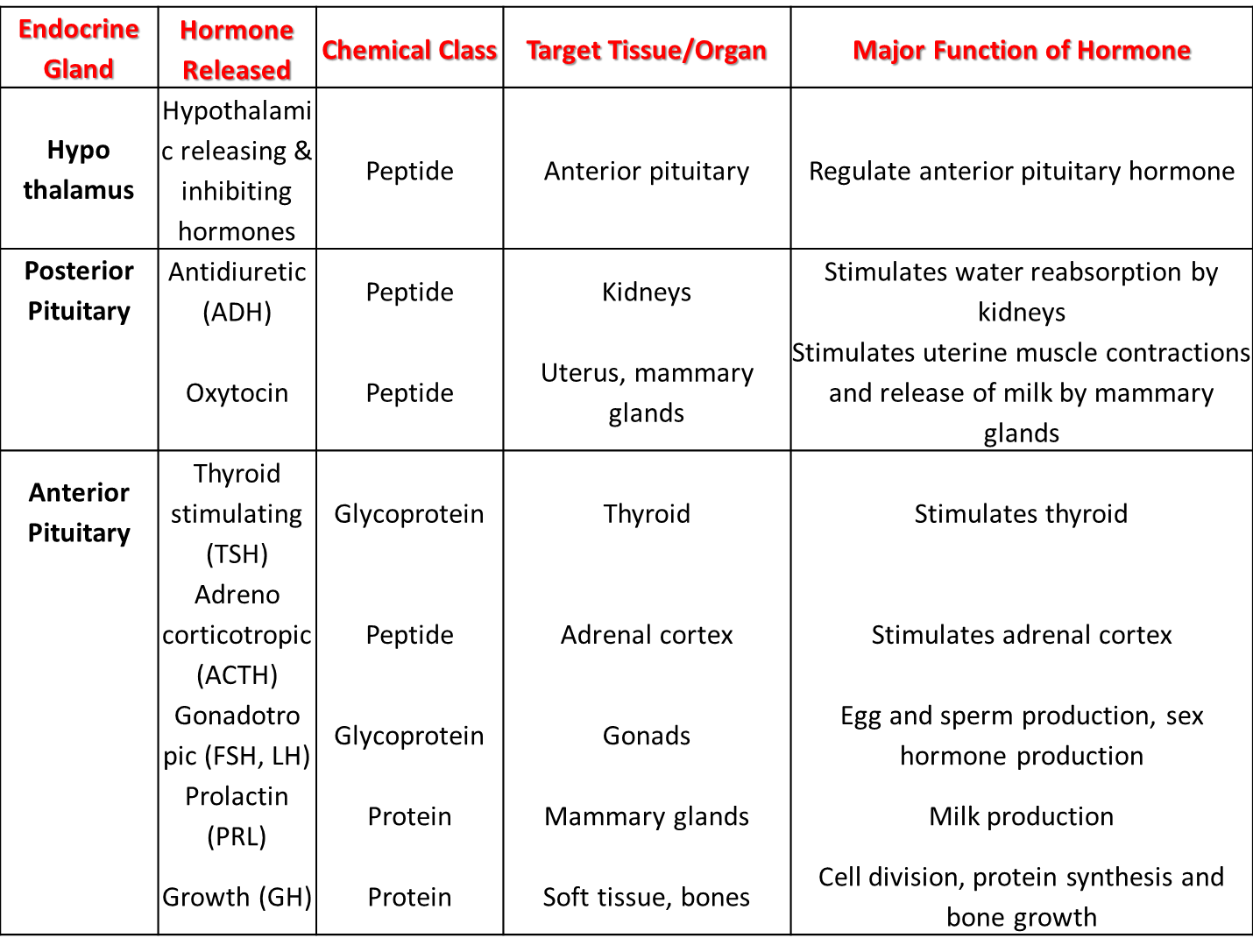
The posterior pituitary gland is the portion which comes from and retains a direct connection with the base of the brain. The hormones of the posterior pituitary gland are actually produced in the hypothalamus of the brain. From the hypothalamus, the hormones are delivered to the posterior pituitary gland, where they are released into the blood stream. At present, we recognize two hormones of the posterior pituitary gland.
a. ADH (Antidiuretic Hormone). ADH is involved with the resorption or salvaging of water within the kidneys. ADH is produced under thirst conditions.
b. Oxytocin. Oxytocin is concerned with contractions of smooth muscle in the uterus and with milk secretion.

ANTERIOR PITUITARY GLAND
a. The anterior pituitary gland originates from the roof of the embryo's mouth. It then "attaches" itself to the posterior pituitary gland.
b. The anterior pituitary gland is indirectly connected to the hypothalamus by means of a venous portal system. By "portal," we mean that the veins carry substances from the capillaries at one point to the capillaries at another point (hypothalamus to the anterior pituitary gland).
c. In the hypothalamus, certain chemicals known as releasing factors are produced. These are carried by the portal system to the anterior pituitary gland. Here, they stimulate the cells of the anterior pituitary gland to secrete their specific hormones.
d. The anterior pituitary gland produces many hormones. In general, they stimulate the target organs to develop or produce their own products. This stimulating effect is referred to as trophic.

Of the many hormones produced by the anterior pituitary gland, we will examine:

(1) Somatotrophic hormone (growth hormone). The target organs of this hormone are the growing structures of the body. This hormone influences such structures to grow.
(2)  ACTH (adrenocorticotrophic hormone). This hormone of the anterior pituitary gland stimulates the cortex of the suprarenal (adrenal) gland to produce its hormones. We will later see that the hormones of the suprarenal cortex are involved with anti-inflammatory reactions of the body.
(3)  Thyrotropin (TSH).  This hormone stimulates the thyroid gland to produce its hormones.
(4)   Luteinizing hormone (LH). LH stimulates ovulation and luteinization of ovarian follicles in females and promotes testosterone production in males.
(5)  Follicle-stimulating hormone (FSH). FSH stimulates ovarian follicle growth in females and stimulates spermatogenesis in males.
(6)   Prolactin. Prolactin stimulates milk production and maternal behavior in females.


Sumber : Bpk. Dr. Iskandar Zulkarnain

#posting tugas cyberprenership
    ahmad baihaqi
    NIM 1112503964

THE PITUITARY BODY


THE PITUITARY BODY

a. Location. The pituitary body is a small pea-sized and pea- shaped structure. It is attached to the base of the brain in the region of the hypothalamus In addition, it is housed within a hollow of the bony floor of the cranial cavity. This hollow is called the sella turcica ("Turk's saddle").
b. Major Subdivisions. The pituitary body is actually two glands-- the posterior pituitary gland and the anterior pituitary gland. Initially separate, these glands join together during development of the embryo.


THE PITUITARY BODY


Sumber : Bpk. Dr. Iskandar Zulkarnain

#posting tugas cyberprenership
    ahmad baihaqi
    NIM 1112503964


The production of some hormones is controlled by positive feedback


The production of some hormones is controlled by positive feedback

In such a system, hormones cause a condition to intensify, rather than decrease. As the condition intensifies, hormone production increases.
           
Such positive feedback is uncommon, but does occur during childbirth, where hormone levels build with increasingly intense labor contractions. Also in lactation, hormone levels increase in response to nursing, which causes an increase in milk production. The hormone produced by the hypothalamus causing the milk let down and uterine contraction is oxytocin.

  
Unlike exocrine and endocrine glands

   Exocrine Glands are those roomates release their cellular secretions through a duct roomates empties to the outside or into the lumen (empty internal space) of an organ. These include certain sweat glands, salivary and pancreatic glands, and mammary glands. They are not Considered a part of the endocrine system.

    Endocrine Glands are those glands roomates have no duct and release their secretions directly into the intercellular fluid or into the blood. The collection of endocrine glands makes up the endocrine system.


Sumber : Bpk. Dr. Iskandar Zulkarnain

#posting tugas cyberprenership
    ahmad baihaqi
    NIM 1112503964


Hormones can be chemically classified into four groups:


Hormones can be chemically classified into four groups:
  1. Amino acid-derived: Hormones that are modified amino acids.
  2. Polypeptide and proteins: Hormones that are chains of amino acids of less than or more than about 100 amino acids, respectively. Some protein hormones are actually glycoproteins, containing glucose or other carbohydrate groups.
  3. Steroids: Hormones that are lipids synthesized from cholesterol. Steroids are characterized by four interlocking carbohydrate rings.
  4. Eicosanoids: Are lipids synthesized from the fatty acid chains of phospholipids found in plasma membrane.


Endocrine glands release hormones in response to one or more of the following stimuli:
  1. Hormones from other endocrine glands.
  2. Chemical characteristics of the blood (other than hormones).
  3. Neural stimulation.


Most hormone production is managed by a negative feedback system

     The nervous system and certain endocrine tissues monitor various internal conditions of the body. If action is required to maintain homeostasis, hormones are released, either directly by an endocrine gland or indirectly through the action of the hypothalamus of the brain, which stimulates other endocrine glands to release hormones.

     The hormones activate target cells, which initiate physiological changes that adjust the body conditions. When normal conditions have been recovered, the corrective action - the production of hormones - is discontinued.
   Thus, in negative feedback, when the original (abnormal) condition has been repaired, or negated, corrective actions decrease or discontinue. For example, the amount of glucose in the blood controls the secretion of insulin and glucagons via negative feedback.


Sumber : Bpk. Dr. Iskandar Zulkarnain

#posting tugas cyberprenership
    ahmad baihaqi
    NIM 1112503964  
 

Human Endocrine System.

Human Endocrine System
Introduction To The Endocrine System


a. The endocrine glands are glands of internal secretion (rather than external, as seen with the sweat glands and digestive glands).
b. This internal secretion results from the fact that these glands have no ducts. Thus, they are often referred to as the ductless glands.
c. The secretions produced by the endocrine glands are called hormones.
d. Hormones are carried by the bloodstream to specific organs or tissues, which are then called the target organs.
e. The activity of the target organ, in turn, affects the activity of the endocrine organ. Thus, it is a reverse or feedback mechanism.


Major endocrine glands. (Male left, female on the right.)
1.Pineal gland
2.Pituitary gland
3.Thyroid gland
4.Thymus
5.Adrenal gland
6.Pancreas
7.Ovary
8.Testis


Hormones activate target cells by one of two methods, depending upon the chemical nature of the hormone.
     Lipid-soluble hormones (steroid hormones and hormones of the thyroid gland) diffuse through the cell membranes of target cells. The lipid-soluble hormone then binds to a receptor protein that, in turn, activates a DNA segment that turns on specific genes. The proteins produced as result of the transcription of the genes and subsequent translation of mRNA act as enzymes that regulate specific physiological cell activity.

Water-soluble hormones (polypeptide, protein, and most amino acid hormones) bind to a receptor protein on the plasma membrane of the cell. The receptor protein, in turn, stimulates the production of one of the following second messengers.

Sumber : Bpk. Dr. Iskandar Zulkarnain

#posting tugas cyberprenership
    ahmad baihaqi
    NIM 1112503964


tanahsakti SUDUT KANAN ATAS